First Week Wheeeeeee!!

Well, turns out three years of practice does make a difference. Earlier this week everyone in spawn was all talking at once, and the 8-year-old facilitator was completely distracted with his lego, and no one had written anything on the board, and I could hear kids from the other spawns already out in the hall, finished with their meetings when we hadn't even started, and I wasn't worried about it. Past Mel would have felt pressured to do something, but I didn't. I resisted the urge to take control, to make the meeting more "efficient," and I was able to tolerate the discomfort (less than it once was, after the practice of many chaotic spawns) because I really do trust the kids now. A big part of it is noticing where my schoolishness wants to eat that trust and actively choosing to reject the impulses of ordering, controlling, and making things smooth; another is recognizing the assumption that order, control, or smoothness are the primary goals of the meeting, rather than authentic presence, reflection, and relationship-building. Time is weird, but sometime in the last three cycles I've begun giving myself permission to relax in noticing the ways that it is circular. Things are how they are right now, so notice them. Be present in that noticing. Spawn is chaotic and that slows things down but we are here: a teen is trying to help the 8-year-old decide how to set the gameshifting board, a kid who has been practicing is sounding really good playing piano, everyone's body posture is relaxed and sleepy this morning. This is only the second day of school. There's plenty of time.

After a summer of littles, I'm particularly grateful to be back in a self-directed space with pre-teens and teens; I was reflecting on this after I spent a lot of yesterday talking to Timo and Iphy. We started with which language-learning apps we like (estamos practicando español!) and then, organically, moved through conversations about gender, patriarchy, the origins of hegemony, conspiracy theories, what money is, individual actors vs organizations, climate change, theories and schemas for manifesting cultural shifts, brains and bodies and networks and emergent strategy and so much more; a pretty comprehensive list of some of my favorite subjects to swirl my brain around. There are lots of kinds of self-directed spaces, and lots of kinds of play, but this particular kind - where we float on a conversational tide of our interests - is one that I love, and am grateful for the intellectual challenge of.

More first week highlights: ramping up a really big D&D game thanks to Xander's enthusiasm and organization, lots of humans playing the piano, reconnecting over our fandoms, listening to culture keepers discuss culture hacking, a smooth(er) cleanup time than the end of last year, sharing books, listening to Sebastian's evil laugh echoing down the hall, the return of Geoguessr, Wikitrails, and Coup, the invention of a new currency, age-mixed Roblox, naming the new projector, and listening to Timo and Iphy explain active voice to Hugo (happening right now!). Exciting things to come: field trips, park trips, the return of volunteer-led offerings like Acro and cook noob, art projects, anatomy and physiology, and a Pokemon showdown tournament (that I might stand a chance in - we'll see!). First things first: the D&D crew got $150 from finance club today to go to the Strand and Forbidden Planet on Monday to get supplies! Yay for a new year!

Check-in and Change-up

note: this is part of an ongoing series that I'm writing about the meetings we have at ALC. Check back for more, and I'll link to them here when they're written.

Intentions for the Meeting

Check-in and Change-up are the two culture-setting meetings at ALC, and one of the cornerstones of the model. By culture-setting, I mean they are the place where we talk explicitly about what kind of school culture we currently have and how that fits into the vision of the school culture that we want. Check-in and Change-up hold space for us as a community to come together and discuss about what’s working and not working for us, problem-solve how to get everyone’s needs met, and make sure that we’re providing maximum support with minimum interference.

At ALC, we don’t have rules but we do have Agreements, so-called because you agree to them as a condition of being a part of this community. Each child signs a formal Student Agreement at the beginning of each school year, which consists of 6 fundamental, non-negotiable parts: Respect yourself and  others, respect shared materials, participate in meetings, share your learning, clean up after yourself, and respect community agreements.

Check-in and Change-up are the vehicle and structure for forming community agreements, which are intended to clarify and hash out the details on the deliberately abstract Student Agreements. Every year I’ve been at ALC-NYC, we’ve made agreements about food messes and clean-up jobs and not cursing at others and telling an adult before you leave the space; often we’ve discussed hoarding shared materials, caring for friends with nut allergies, and how to make our other meetings go more smoothly. Community agreements are powerful because they are formed by the kids who show up in collaboration with the adults who hold the space. If you don’t agree, you have the power to change them - through these meetings.

I’m referring to Check-in and Change-up together (and sometimes interchangeably) because at ALC-NYC they are inextricably linked, though they are technically two separate meetings. I’ll go into more detail in a moment, but as an overview: Check-in is a mandatory, all-school meeting where we go over the Awarenesses from the week and create an agenda. Then, we adjourn Check-in and anyone who wants to can leave. After, we immediately start Change-up, where those who have opted in stay to work down the agenda in an informal conversational setting, creating new community agreements, tweaking the ones we already have, or coming up with alternative, creative, artistic solutions in response to the awarenesses we discussed in Check-in.

So: they’re distinct but intertwined meetings, with an open and iterative structure, intended to support community members in collaborating to create a school culture that nourishes our mutual sense of safety, dignity, and belonging.

Let’s get into the details.

When It Happens

At ALC-NYC, we do Check-in/Change-up every Friday morning, immediately following morning Spawn. They day is less important than the frequency and consistency: since we have school 5 days a week, once a week feels like a reasonable amount of time to check in on how everyone is doing. I like the rhythm of ending the week in collective reflection and starting next week with something new. Lots of ALCs do it differently - you’ll be able to feel out how frequently your community needs to change things up.

Tools We Use

For this meeting we use something called a Community Mastery Board (or CMB) which is simply a whiteboard divided into several columns: Awareness, Testing, Practicing, Mastered, and Archive.

A whiteboard divided into 5 columns labeled "Awarenesses" "testing" "practicing" "mastered" and "archive". There are colorful post-it notes in the last three columns. The board is labeled with a sign that says "community mastery board"

Unsurprisingly, we use post-it notes to interact with this tool. We also use a second whiteboard for creating the agenda and taking notes on it.

How It Usually Goes at ALC-NYC

Throughout the week, any community member can add an Awareness to the CMB. Awarenesses are observations, things that we notice that are or are not working for us. Sometimes they arise out of conflict: one kid gets mad at another because they’re hoarding Lego and puts up the awareness “hoarding legos isn’t cool.” Sometimes they’re clarifying something we’re already doing: the awareness “people are graffiti-ing on the bathroom stalls.” Sometimes they’re a question for the community: “can we get a hamster?”

Friday, the whole school crowds into the Red Room and starts Check-in. The facilitator (sometimes an ALF, sometimes a kid) pulls a sticky off the CMB and reads it aloud, asks if the writer of the sticky would like to speak more about their awareness, and hands the sticky to the scribe, who puts it on the whiteboard and adds some notes to create the Change-up agenda. Sometimes discussion breaks out about one awareness or another, and the facilitator reminds the group that if you’d like to talk more about this you can come to Change-up, then redirects attention back to the next awareness. When all the awarenesses have been read, we adjourn Check-in and then immediately begin Change-up.

We split the meetings a few years ago because the school had grown to the point where it was more of a drain to get everyone to participate in Change-up than it was productive and supportive to the health of the community. It’s worth noting that the majority of students leave at this point - those who stay are a self-selecting group that we informally refer to as culture-keepers. These are the people who are showing that they’re invested in creating and maintaining a healthy culture at the school. I try and talk less than the kids do because I’ve learned that if I don’t fill the vacuum, they often surprise me with their brilliance. It’s hard to trust kids and it’s also fundamental.

At Change-up we work back down the agenda (using a different color marker to make notes) and decide for each item - was this just an announcement? Should we make a new agreement? Should we do something else (like write a rap about food messes, or create a sign to clarify microwave use, or convene a culture committee to talk to the people involved) instead?

If we decide to make a new agreement, then we try and collaborate together on something everyone in the room is willing to try out for a week. We call this Testing, and all of our new agreements go through this phase. We don’t vote on new agreements. Instead we talk about wording and usage and enforceability until the folks in the room are satisfied that we can try it for a week and see how it goes.

The next week, we’ll announce the testing agreement at Set-the-week on Monday morning so the whole community knows, and then let it flow. The following Friday, we’ll ask in Check-in how everyone felt about it - thumbs up if we should keep it, thumbs down to rework it. If we get a clear yes, we’ll add the agreement to Practicing, where it will live with the other agreements we’re actively practicing as a community (and maybe one day all the way to Mastered, which is where we put agreements that we’re practicing without even having to think about!). If there’s ambivalence, we’ll add the testing agreement back to the Change-up agenda to talk about again.

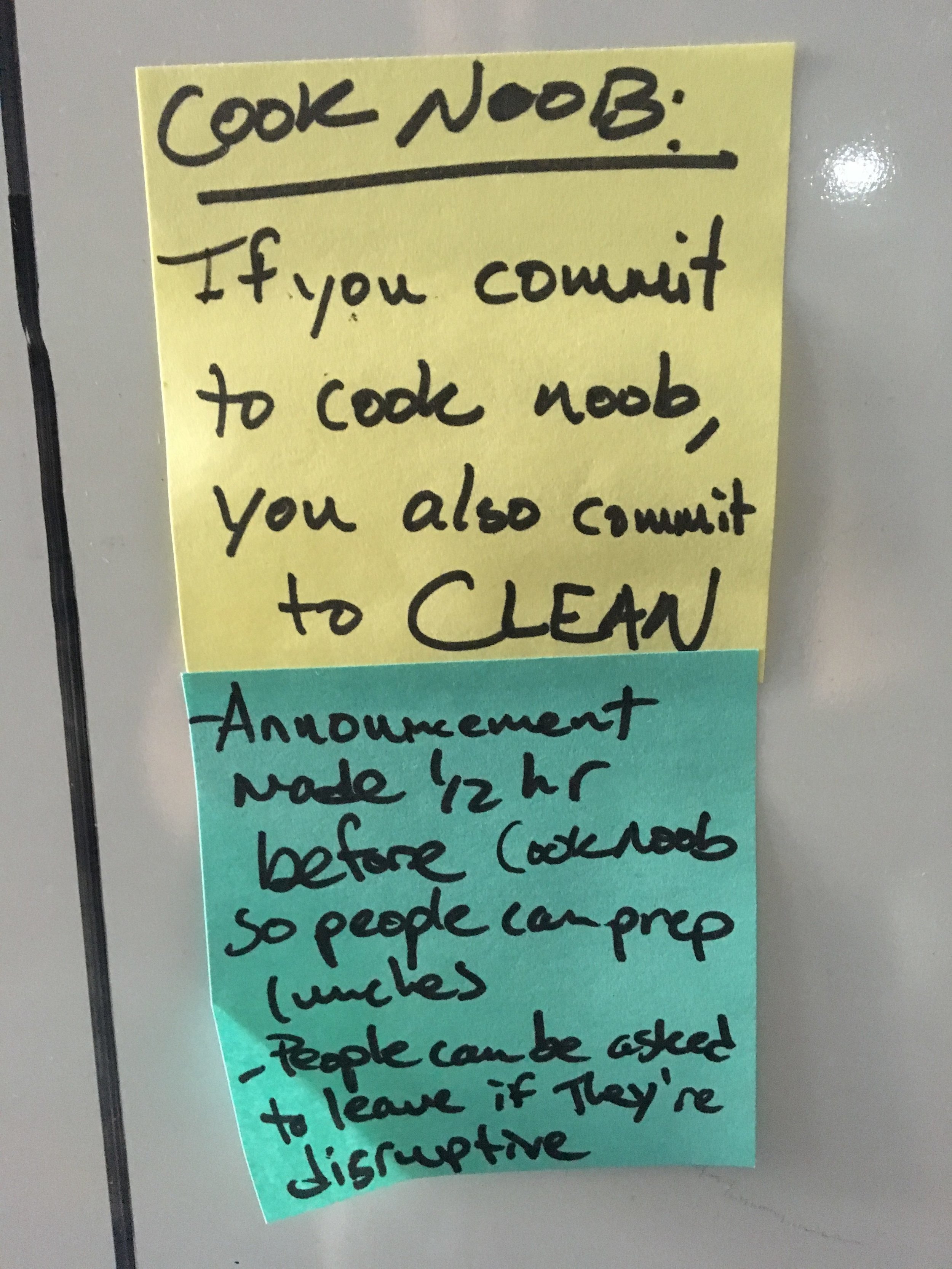
a yellow post-it note that reads "we're not doing and good job of cleaning up cook noob -Chuck"two post-it notes, one yellow and one blue, that read "Cook Noob: if you commit to cook noob, you also commit to CLEAN. Announcement half hour before cook noob so people can prep lunches. People can be asked to leave if they're disruptive."

The iterative nature of creating agreements is intentional and fundamental. In practical terms, it streamlines the meetings because it eliminates the need to speculate on every “what-if” situation when creating an agreement - if we add a new testing agreement, and something unforeseen comes up while we’re testing it, then we can easily adjust and test something else. More abstractly, it’s aligned with our philosophical roots: “learning happens in cycles of intention, action, reflection, and sharing.” The meeting often feels both focused and informal, and our notes reflect it - they’re messy, full of doodles, written in shorthand and inside jokes. Change-up is a powerful weekly that reminds us we are in community with each other, and trying to care for one another as best we can.

Once we finish going through all the agenda items, we adjourn Change-up and we’re done (for this week)!

Final Notes

I’m often asked what the difference is between ALCs and Sudbury/democratic free schools, and the way we go about creating community agreements is certainly one of the primary differences. My understanding is that at those other schools, rule-making is often done by a body (like a Judiciary Committee) that requires mandatory service from all the students on a rotating basis, rules are voted into effect by a majority, and rules created in that setting carry over from school-year to school-year. All of this is also intended to give kids a chance to practice the democratic process.

At ALC, Check-in is attended by everyone in the school and done quickly, while only the students who care to attend Change-up to brainstorm solutions - as I often remind kids, decisions are made by those who show up. We don’t vote. Instead, we look for solutions that will satisfy everyone in the room enough to cross the threshold are you willing to try this for a week and see how it goes? They’re deliberately nonherirarchical - in Change-up particularly, we don’t raise our hands to be called on by a presiding officer but speak informally with one another. There is a facilitator to keep everyone focused, but that facilitator doesn’t have to be an adult. The agenda is created out of our shared intentions for the week, which are added to a whiteboard that everyone has access to at all times in the space. The process is iterative, the agreements fluid. At the end of the year, we clear out all of the agreements that we’ve created, trusting that if the need arises, we’ll re-create them next year (or iterate something better, or find a way to support each other informally so we don’t need to create a formal agreement, or…).

Sometimes people asks me how this could possibly work and I offer this analogy: you’re going out to dinner with your friends, and trying to decide which restaurant to go to. I’m gluten free, so we can’t eat Italian, but you’re vegan, so no sushi, and another friend doesn’t want to travel far because they’re exhausted and we need a place that’s wheelchair accessible and… we account for all those things. We choose an accessible taco place that’s nearby our tired friends’ house where I can have corn tortillas and you can have soy tacos and everyone gets to eat together, which is the thing we really wanted. Check-in and Change-up are tools for making explicit what happens implicitly in that decision-making process. They’re tools for taking care of each other.

Which leads me to my final note: probably your Check-in and Change-up won’t look like the one I’ve just described and that’s great. How frequently you meet, where, which tools you use, the specific language about agreements and awarenesses, the timing of the meeting, who facilitates it, how you take notes - all of these things (and more!) are changeable. It is only ever my intention to tell you what we practice because it works for us, and to invite you to change up what needs changing up so that these meetings work for you too.

Tag! Tag! Tag!

This is a list of tag games that I like! We play a lot of tag, and these varieties keep it interesting. The descriptions under each are as close to word-for-word how I explain them to new players. [Notes in brackets are my reflections on the game conditions.]

We often play many rounds of tag in a row. All of these games can (should!) be modified to meet the needs of the players. The ideal tag game is really intense and leaves everyone breathless, bone tired, and full of endorphins.

Banana Slug Tag

Everyone is It. If I tag you, you are frozen until I get tagged. When you are frozen, you must t-pose until I am tagged so that other players know you're frozen. If we tag each other at the same time, or if there is any dispute, then we play rock-paper-scissors and the loser is frozen. You win by freezing all the other players. Go!

[This is a hard game to win! It's best played in a space where it's easy to see all the other players - open fields, small playgrounds, a gym. The minimum number of players is 4, but the more players you have the more fun it is.]

Hide and Seek Tag

One person is It, everyone else hides. Once you get tagged by the person who is It, you also become It. You don't have to stay in your hiding spot - you can move around as much as you want. The last person tagged gets to choose who is It for the next round.

[You can play with 3 or more people, but this is also much more fun with more humans. Obviously, you'll want to play this game somewhere players will have lots of places to hide...]

Toilet Tag

One person is It. When you get tagged, you are frozen and you have to kneel down on one knee (now you are a toilet). To unfreeze you, an free player must run over, sit on your knee, and "flush" one of your arms. You win by turning everyone into a toilet.

[This game works in a lot of different settings! Be careful of your knees, grownups...]

Hug Tag

One person is It and everyone else is running - to avoid getting tagged, players can hug for up to 5 seconds (they should count down from 5 out loud). If you are hugging, then you are safe and cannot be tagged. If It tags you, then you are It.[This is an infinite tag, and great to play with a group who is practicing trust-building with each other...]

Shark Tag

There are two bases, on two different sides of the room or field or playground. One person is the Shark - they're It. They stand in the center. Everyone else starts on the base on one side, and must all run over to the other base. If you get tagged on the way across, you also become a Shark. Last player standing wins.

[We play endless varieties of this one. Sometimes, the Shark has to tag the other players by throwing a gator ball at them. Sometimes, we add other bases, or institute a time limit on how long you can linger on base. I like playing this game in a place where there are a lot of obstacles, like a playground. I also played this in a pool as a kid...]

Blob Tag

Two people hold hands and they are the Blob. They are It, and if they tag you then you will hold one of their hands and also join the Blob. The last player standing wins.

[This is best played in a smaller space with fewer obstacles, which makes it progressively easier for the Blob to trap free players.]

Monster and Sausage Tag

One person is the Monster - they are It and they are chasing a Sausage. Everyone else lays on the ground in groups of 2 - they are a Sausage Pack. The Monster chases the Sausage until the Sausage lays down a joins a Sausage Pack. Then the Monster becomes a Sausage, and the person on the other side of the pack gets up and becomes the Monster.The really important part about this tag is the screaming. The Sausage must sound adequately terrified (no one wants to get eaten by a Monster!!)  and the Monster must sound appropriately terrifying (or else what kind of Monster are they??). If the Monster tags the Sausage, the roles are reversed.

[Monster and Sausage tag is an infinite tag, and best played somewhere you don't mind laying down on the ground. Obviously, don't play this game somewhere where you will subject people to your screaming who did not consent to it. Also, this game is hilarious. Play when you need a good belly laugh.]

An Unabridged Free Write

Wow we’re silly today. I usually feel a rush to get started in writing time but today I feel really spacy and all over the place and you know what that’s fine that’s what we’re doing I’m not wordsing great but I’m wordsing and that’s what counts. It’s Wednesday and it feels like this week has been endless and that’s probably because I didn’t give myself any introvert space this weekend. I’m not mad about having plans - I went to painting class and saw my family and hung out at Chuck’s birthday party and met some cool humans - but then suddenly it was Monday and I had school and it’s a visiting week and on Monday nights I do the ALF call and then I went to bed and had some really intense dreams and woke up and it was Tuesday and it’s still a visiting week and with all the people in the space we had almost 40 people here! And then after I took Saylor and Zoe home on the subway and then my roommate locked herself out and our train was delayed and so I was texting everyone to meet me at the climbing gym and then everyone did and I felt weird about having my life spheres all colliding - introducing Saylor to my friend Mimi and then giving my roommate my keys and pointing out Zoe to her (she’s heard many tiny Scorpio stories). And then I went climbing and that was awesome because I did so good and I finished a V3 I’ve been working on for WEEKS and it felt so good and then I also almost finished another V3 and then I went out to dinner with my friends Mimi and Lou and Yael and that was wonderful because it’s a safe queer bubble I get to be in every week that feels so good but also it’s a late night and I didn’t get home until after 10 and Arielle (that’s my roommate) had to let me in cause she had my keys and it’s her last week at work and so we talked about that and so I didn’t get to bed until after my bedtime which was fine but then I had more intense dreams (Neptune and Mercury are dancing around each other all week, which might account for it - they’re not bad they’re just out of reach) and I wake up thinking and it’s loud in my head.

I’m anxious that I embarrassed Saylor yesterday when I introduced her to Mimi and that I’m just repeating myself about volume stuff and nothing is moving and I have plans tonight and tomorrow and Friday and Saturday and I had to tell a friend who I’ve been having a hard time connecting with that no, we can’t hang out Sunday and I didn’t say that it’s because I desperately need time to myself alone with no plans, even though that’s true, because I feel guilty about needing that even though that’s being mean to myself. I want to absolve myself of that guilt but it’s hard when our culture is like GO GO GO especially in new york where everyone has plans all the time and that’s not my preference but I’m doing the best I can to exist in capitalism and take care of my mental health and my vibrating nervous system and[that’s the point at which the timer ran out - for instructions on how to do a free write, check out Beth’s blog post here and mine here. What follows is an addendum.]

Some days (especially when I haven’t had introvert time to soothe my body and listen for what I really need in what can feel like an endless monologue of brain-chatter-anxiety) I feel really overwhelmed by it all. I have a diagnosed anxiety disorder - when I say I feel anxious I mean it clinically. I am doing a lot of work to try and move through the world in ways that ease it - from therapy, to journaling, to learning to meditate. On the other hand, I feel an intense impulse to edit the self that I present to the world - to appear at ease and in control, to not ask for space or time that I need, to put the [perceived] needs of others before my self. I’m posting this as-is to counteract some of that editing, to put out into the world some of my self as I experience them. Thanks for witnessing <3